Labyrinth

Trinity’s Labyrinth is located outside on the north side of the property in the Courtyard.
What is a Labyrinth? A labyrinth is a single path which leads, via a circuitous route, to the center and back out again. Although like a maze, a labyrinth is designed for ease of navigation and it is impossible to get lost within one. Our Courtyard design is known as a Classical Seven Circuit Labyrinth. You enter the labyrinth through the mouth and then walk on the paths defined by the dark colored pavers. The goal is in the center of the labyrinth. When you reach it, you have gone half the distance – you now need to turn around and walk back out.
How are labyrinths used? Traditionally, people walk a labyrinth for many reasons. It is used to facilitate prayer, reflection and spiritual transformation. Some do it to relax, some as a walking meditation, some just for fun. While many walk a labyrinth simply with an open mind for whatever happens, others learn to use it as a more intentional spiritual discipline. Several guides are available for your use, if you desire
What is the history of their use? Labyrinths are ancient. The labyrinth was a central feature in European churches in the middle ages and many of these still exist today. Labyrinths have been used by a wide variety of cultures for at least 3,500 years. Evidence of ancient labyrinths exists in Crete, Egypt, Italy, Scandinavia, and North America. The most famous of these remaining labyrinths is at Chartres Cathedral near Paris, France. It was walked as a pilgrimage and/or for repentance. As a pilgrimage, it was a journey to become closer to God. When used for repentance, the pilgrims would walk on their knees. The cross is at the center of the pattern of many labyrinths and is used in the construction as a guide. Even today, churches with labyrinths encourage people to walk the labyrinth during Lent and Advent.
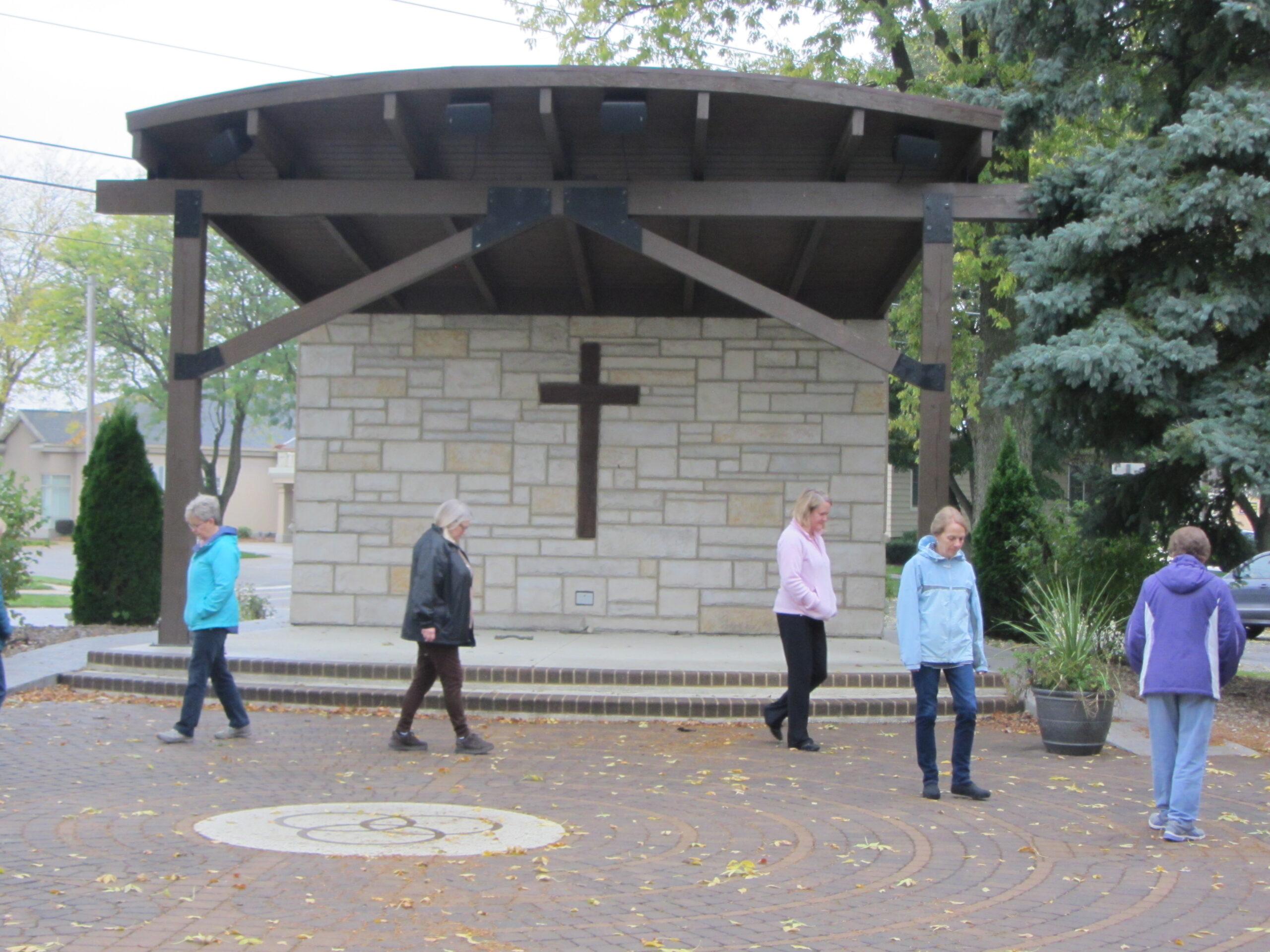
What does Trinity intend to do with this labyrinth? As part of the courtyard, the labyrinth is available to both our Trinity members and community members at any time as an opportunity for spiritual growth, meditation and prayer. We hope that people will see Trinity as a center for many kinds of spiritual expression in the community. We also hope to have periodic workshops which will help people become more informed about its uses and benefits.
What are the health benefits of walking a labyrinth? Herbert Benson, MD, founder of the Benson-Henry Institute for Mind Body Medicine at Massachusetts General Hospital, has found that focused walking is highly efficient at reducing anxiety and triggering a “relaxation response.” This effect has significant long-term health benefits, including lowering blood pressure, slowing breathing rates, reducing incidents of chronic pain, and reducing insomnia.
What are the spiritual benefits of walking a labyrinth? More than just walking in circles, walking a labyrinth can be a spiritual practice of prayer and focusing on priorities in life. Labyrinths encourage an embodiment of our faith as we continue our daily routines in life.